Deprecated: ProcessWire\MarkupQA::__construct(): Implicitly marking parameter $page as nullable is deprecated, the explicit nullable type must be used instead in /var/www/vhosts/veravandeseyp.com/type.veravandeseyp.com/wire/core/MarkupQA.php on line 74
Deprecated: ProcessWire\MarkupQA::__construct(): Implicitly marking parameter $field as nullable is deprecated, the explicit nullable type must be used instead in /var/www/vhosts/veravandeseyp.com/type.veravandeseyp.com/wire/core/MarkupQA.php on line 74
Deprecated: ProcessWire\MarkupQA::findLinks(): Implicitly marking parameter $page as nullable is deprecated, the explicit nullable type must be used instead in /var/www/vhosts/veravandeseyp.com/type.veravandeseyp.com/wire/core/MarkupQA.php on line 623
In this work, I aim understand better in what ways AI can impact type design through literature reviews, interviews with type designers, practical experiments, workshops, talks, and surveys. See Evaluation for the latter three. These components are divided in three sections (A) Automation, (B) Interface and (C) Creativity.
Experiments
The project is built around a series of practical experiments that aim to reflect the qualities mentioned below. These experiments are also referred to as prototypes, artifacts, and tools. They are divided into three research areas in which I believe current type design tools could be further expanded. The prototypes do not necessarily meet the full technological potential available at this time but rather serve as an example of what may be possible in the near future.
- Experimental The artifacts are experimental. They are not meant to replace traditional type design software to the extent that they will be produced within this work but rather offer alternative ways of making, automating, and interfacing.
- Computational These tools all live in the digital realm rather than being physical objects or tangible interfaces. In most cases, they should employ the benefits of computation without letting the user do (too much) computation themselves.
- Playful While some artifacts might be slightly more serious, the experiments tend to be playful and light. They are meant to serve as thought experiments, not as software that will change the world.
- Bespoke Rather than an all-around suite of everything that can be done with typography, these tools offer custom solutions for specific aspects of type design.
- Intuitive The tools should feel intuitive to use, with a low to medium learning curve. Learning how to use the tool should be possible for an average user within an hour.
- Optimistically avant-garde While considering the history of type design, these tools should function in the present and make us think about the future of creativity.
Expert interviews
To understand the world of computational typography, I helped organize the free online “Lunch Lectures: Computational Typography” series at the MIT Media Lab. The speakers were Beatriz Lozano, Talia Cotton (Cotton Design), Daniel Wenzel (DIA Studio), Just van Rossum, Peter Cho, and Space Type Studio.
Another series of interviews was conducted with computational type designers and studios that develop their own type tools: André Burnier, Andreas Gysin, Beatriz Lozano, Daniel Wenzel (DIA Studio), Giang Nguyen (Gydient), Kiel Danger Mutschelknaus, Sander Sturing (Studio Dumbar), Marc Schütz (Schultzschultz), Talia Cotton (Cotton Design). The aim was to construct a qualitative insight into computational typography, how computational designers make tools, and how they are received.
To get an insight into type designer’s needs, interviews were conducted with some contemporary (mostly Latin) type designers: Fabian Harb (Dinamo), Alex Slobzheninov (Pangram Pangram), Charlotte Rohde, Just van Rossum (Type/Media), Kai Bernau (Atelier Carvalho-Bernau), Tran Giang Nguyen (Gydient), and Alice Savoie (ECAL, FrenchType).
Some of these designers’ quotes are visualized and discussed throughout the thesis, to better understand the status quo.
Ethical guidelines
In preparation for the experiments, the following ethical considerations were defined for good practice.
The TLDR; of this section is:
- Include non-Western references, and aim for scalability to other non-Western scripts;
- Be inclusive in the curation of interviewees, background references, and reading material;
- Do not purposefully infringe on other designer’s work, and beware to do it unpurposefully;
- Table type design rules where needed but acknowledge their value;
- Design for friction instead of the average;
- Be transparent about the data sources of all prototypes that use generative AI. List possible dangers that come with it;
- Use generative AI to assist in brainstorming and co-creation, but not to create final form.
- Make environmentally sustainable choices.
I try to create space for students to engage in critical conversations about cultural appropriation and the legacy of colonialism as they consider their own roles and responsibilities as designers.
— Sabiba Basrai, Type History Toolkit, Part 2: De-Centering the Latin Letter in Design Education
I can only understand Latin type
As we saw, letters are embedded with the history and ideas of what society should be, and how we communicate [Anderson 2022]. Yet, just like the origins of serifs, this project only explores Latin type. Unfortunately, that is the only script I can comfortably write in (apart from a handful of Mandarin characters—but let’s not go there). It is important to note that this principle of technology embedded in typographic writing systems is universal and not prelimited by the West.
Take, for instance, languages like Punjabi, Thai, and Telugu. Their curly, continuous lines are visual opposites to the hard, composite chisels that shape Latin letters. Perhaps because the medium was opposite—a popular theory is that these curly languages were designed to be written on leaves [Ghosh 1983]. This adheres to the idea that the limitations of our tools define our designs.
Deprecated: ProcessWire\Pageimage::extras(): Implicitly marking parameter $value as nullable is deprecated, the explicit nullable type must be used instead in /var/www/vhosts/veravandeseyp.com/type.veravandeseyp.com/wire/core/Pageimage.php on line 1779
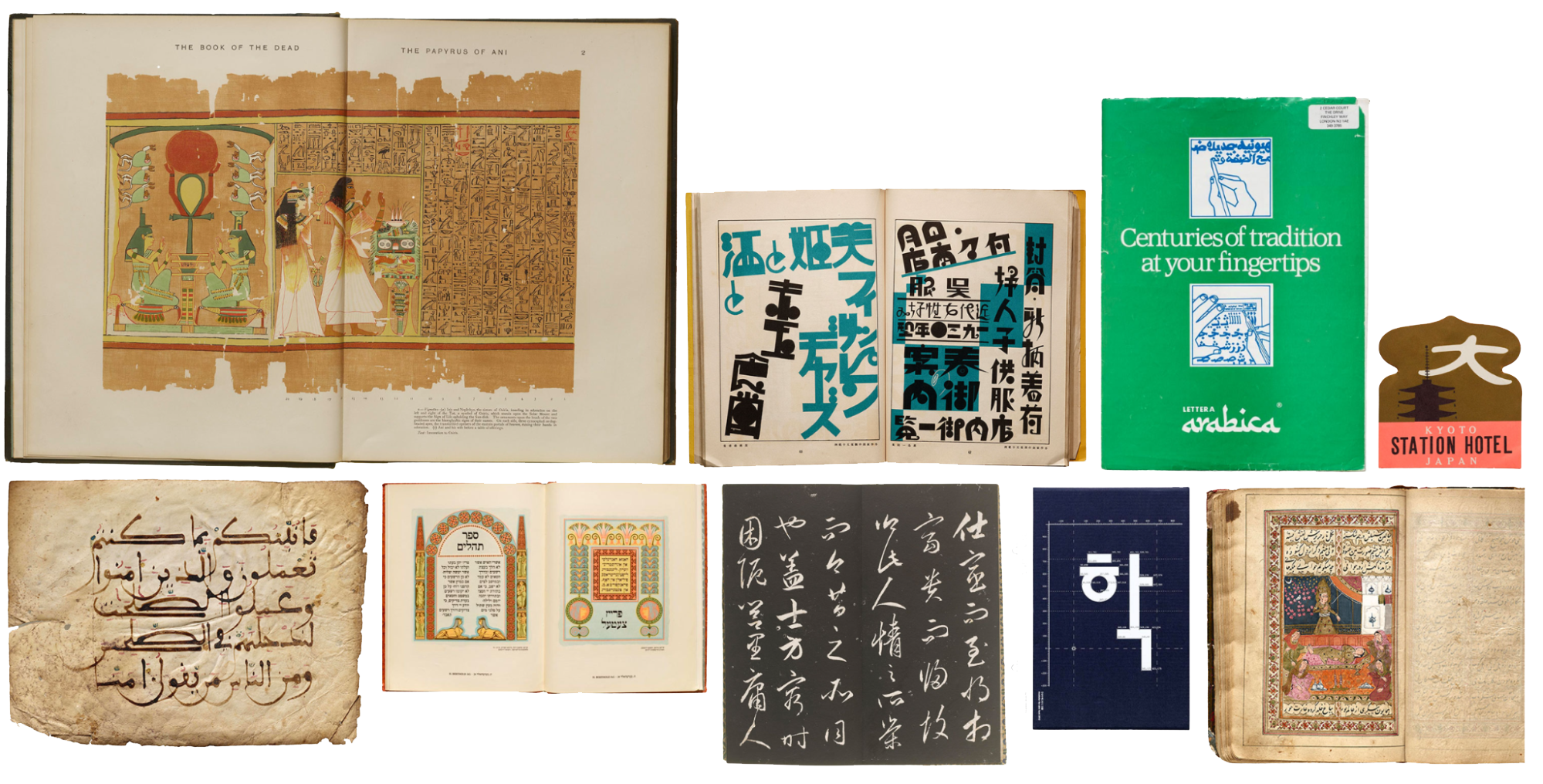 Sabiha Basrai, Letterform Archives
Western perspectives on type design of course do not nearly begin to encapsulate global typographic diversity. While this thesis focuses on Latin scripts, I want to consider how this work can both be inspired by and extended to non-Western scripts and principles. This is crucial to ensure that the thesis doesn’t inadvertently perpetuate a solely Eurocentric view of typography.
In Letterform Archive, artist and educator Sabiba Basrai reflects on ways to unlearn her own assumptions about best design practices. She proposes that educators have the chance to provide non-Western reference points for concepts in color theory, pattern, and typography. Learning about these also allows for our imagination to grow.
 Indian calligraphic stylus types, Pijush K. Ghosh (1983)
 Palm leaves make square shapes blotter
Nobody is going to give you the education you need to overthrow them
In addition, neither type design nor computation are diverse fields. Unfortunately, that’s exactly the intersection we find ourselves at. Western white men make up a big part of both the history of Latin type and computation. (I almost named the history sections ‘white men doing type things’, but collected myself in time.) For decades and even centuries, one small demographic defined what “good” type and design were. Sometimes, it takes some references outside of this scope to reconsider how this space can be more inclusive. As civil rights activist Assata Shakur put it, “Nobody is going to give you the education you need to overthrow them.”
Don’t steal artists’ work
Enter intellectual property: It is not unthinkable that some AI-generated typefaces would (intentionally or unintentionally) resemble existing designs. Many large AI models, especially generative AI, have been trained on large sets of “neutral” images, text, and letters. However, as University of Washington linguist Emily M. Bender puts it, “There’s no place where you can go download the Internet.” Amassing data is tedious work done with web “scrapers” or “crawlers”, backstage by developers, without any public-facing guidelines on which data are included—and which ones aren’t. Jesse Dodge at the nonprofit Allen Institute for AI says that, when using services like Common Crawl (used for OpenAI’s GPT-3) or the LAION dataset (used for Stable Diffusion), personal data is very likely to be part of the collection, and it will remain long after the website is gone [Leffer 2023].
Major generative AI developers like OpenAI, Meta, and Stability AI have been facing lawsuits for training on data that is not allowed, but creating accountability by reverse-engineering the origins of data takes incredible effort. Creatives have formed initiatives to opt out of their work being used for training, such as ‘Have I Been Trained?’. This initiative offers an API for large AI organisations, so they can filter out the creatives that have opt-out. However, there is no sign that the organizations have adopted the API [Spawning.ai 2024]. Hopefully, the lack of care for data sources is a sign of the times, and in the future, we will have more effective mechanisms to hold big companies accountable.
Type design poses an interesting challenge to the notion of intellectual property because it can be incredibly self-referential. Designing revival typefaces is common practice [Shaw 2017]: especially those serif typefaces are often reinterpretations of historical typefaces. Type designer Charlotte Rohde mentions that she noticed that many graduation projects at type design programs like ECAL MATD and Type/Media are revivals. What does intellectual property mean in a creative field that is rooted in reuse? If designers are allowed to redraw something, then why not with AI?
Respect the craft
Traditional type designers might view AI-generated typefaces as undermining the skilled craftsmanship involved in type design. Even when I break some rules in some experiments, that does not mean those rules should always be broken. However, it is much easier to work on experimental projects when eliminating other restrictions for the time being.
These experiments serve as thought experiments complementary to existing tools, not as a replacement. I highlight ways to potentially enhance and expand the creative design process rather than devalue the human element in type design.
Avoid the average
The age of average, a term by strategy director Alex Murrell, describes the phenomenon where design, architecture, fashion and media have become dominated by uniformity and predictability. It argues that global trends and market forces dictate the need and lead to a homogenization of aesthethics [Murrell 2020]. In their manifest Designing Friction, artists Luna Maurer and Roel Wouters argue that we should instead design friction. Friction in his sense does not mean conflict or malfunction, but it means designing interaction for experiences that are not soulless, but catch our attention, reflect and criticize [Maurer and Wouters 2023].
Be aware of bias
If everything is trained on trained content, things just become more monotonous, and not necessarily better. Such a process works like an echo chamber over time [Mulligan 2024].
Researchers have noted that biases in generative AI training sets can perpetuate stereotypes or reinforce existing inequalities if not properly addressed [Esmaeilzadeh 2023]. Shaping opinions or basing decision-making processes on these biased models may not reflect society's best interests. It is essential to remain vigilant about the inherent biases within AI training sets and strive to mitigate their influence on our work. Ensuring diverse representation in the data sources used for training can help reduce bias and create more equitable outcomes. In cases where data sources are not transparent, this should be clearly mentioned and addressed.
Don’t believe the hype
Another big risk with AI—especially with generative AI—is the ease with which one can create low-quality, hollow, or even aesthetically displeasing results, that can only be interesting when somebody hasn’t seen it before. While I like to call this phenomenon “visual sauce”, it is more commonly referred to as “AI garbage” [Mulligan 2024]. Implementing quality controls and curation processes will eventually be crucial to the usability and appeal of the generated typefaces. AI-generated work has to serve a purpose beyond mere novelty. They should offer utility, aesthetic value, or meaningful innovation in the field of typography.
Take, for instance, this specific set of adjectives in scientific papers. Since the release of OpenAI’s ChatGPT-4 in 2023, the use of the following adjectives has skyrocketed, especially in AI-related papers. Notice that the adjectives “innovative,” “intricate,” and “meticulous” all promise something shiny. However, they sound hollow and almost appealing when overused or used in the wrong context.
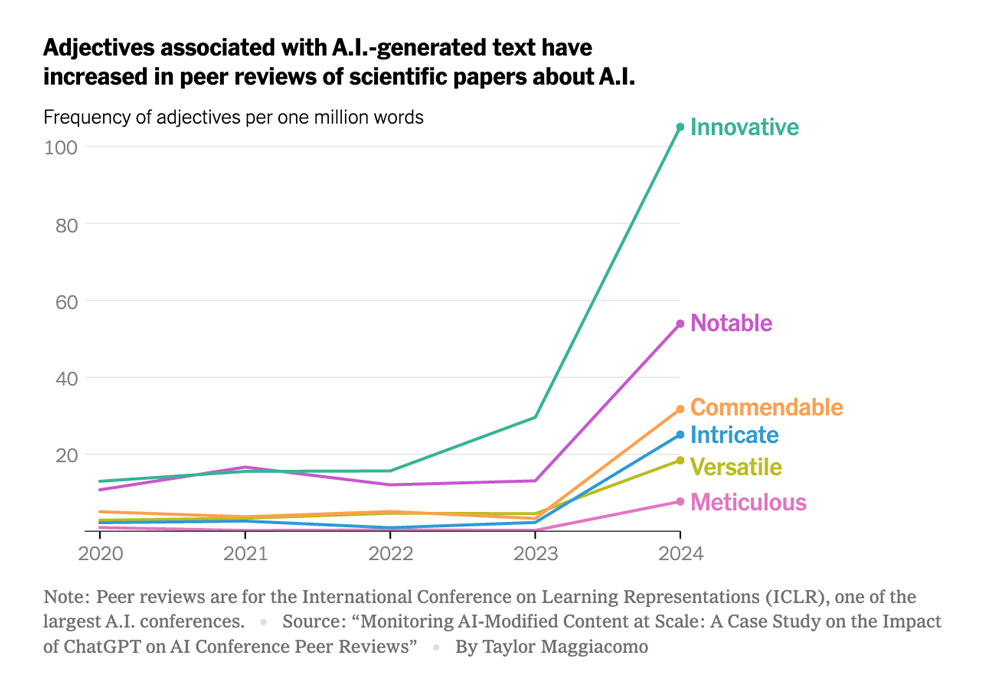 Technology Review, Mulligan (2024)
This poem by Joseph Fasano, titled For a Student Who Used AI to Write a Paper, encapsulates another argument in favor of making meaningful work rather than automated work.
Now I let it fall back
in the grasses.
I hear you. I know
this life is hard now.
I know your days are precious
on this earth.
But what are you trying
to be free of?
The living? The miraculous
task of it?
Love is for the ones who love the work.
I believe that “AI garbage” can be avoided when the visual output of generative models is solely used in an early stage of the design process, for example in brainstorming or sketching. That way the characteristic properties are used for good.
Practice sustainability
The environmental impact of using generative AI should also be considered with any work that is made, because working with AI models can be resource-intensive. I aim for as many sustainable practices in my computational work as possible. When experimenting with a few environmentally controversial models like ChatGPT and DALL-E, I set a hard limit on the maximum calls for this project (300) and used the smallest, shortest versions possible. When using AI libraries, I loaded in the local version to avoid unnecessary traffic. Same for other data that was loaded into the experiments. However, it might not be enough, and it might be worth considering avoiding models like this for art and design altogether.